Wednesday, 4 December 2013

Lamington to Wollongong

We arrived at Brisbane Airport after leaving Queensland safely and on time, it shows the immense distances involved in travelling around Australia in that we had flown for nearly 3 hours and were still in the same state. It was fairly straightforward picking up our camper van which was to be our home for the next 12 days although later developments proved that things were not as easy as first thought. Our salesman there kindly set up an account to cover travelling on the Toll roads. Despite his assurances that this would cover me in both Brisbane and Sydney this was not the case and the account he set up was valid for Queensland only and as a result I was hit with 5 unpaid toll fines and 4 administration fees from Apollo themselves leaving me around $360 out of pocket which still has not been resolved even though it is apparent that Apollo themselves bear responsibility. Currently Apollo's only answer is that they gave me a magazine outlining the toll system and have offered to refund some of their administration fee, but I feel that although it is not part of their remit to set up Toll payments their salesman offered to do it for us and assured me that I was covered in both Brisbane and Sydney so why should I need to investigate further and even if I had read this newsletter would that have told me that a temporary pass set up with GoVia ( the toll company) was only valid in Queensland.

As these issues only came to light several weeks after our return to the UK I can only say that picking up the camper van went smoothly and we were soon on our way. We reached Canungra without incident and topped up with provisions for the stay in the Lamington National Park however we missed the turning here being intent on finding a supermarket and wasted over an hour travelling the wrong way. Eventually we realised and returned to Canungra and finding the correct road started the drive up to the campsite next to the famous O'Reilley's Rainforest Lodge. The road was only around 32kms but it was not for the faint-hearted, very steep, lots of hairpin bends, blind corners  and minibuses coming to other way meant to say at the least I had a very nervous passenger and was glad to arrive after what felt like an eternity. A Noisy Pitta flew across our path as we neared the campsite.  Consequently we arrived much later in the day than we had hoped taking nearly double the time Google maps had told me it would and there was only time for a quick walk to get our bearings before dark but we did get to see our first Wonga Pigeon and the Pademelons in the campsite were now of the  Red-necked variety.
National parks campsite outside O'Reilley's in Lamington NP
Red-necked Pademelon
King Parrot
Crimson Rosella

We were awake next morning at first light full of anticipation, as we ate breakfast we were joined by a ridiculously tame Satin Bowerbird. We walked up to O'Reilley's hoping to be able to have a look round before it became busy there were already a couple of birders wandering around and after a chat to one of them we started to wander down the track we had not gone far when he appeared again and called me back although our target had disappeared again after a brief wait I peered over a fence into a little garden and there only a few feet away was a pair of Albert's Lyrebird and where was the camera oh yes back in the camper van.!  A couple of Wonga Pigeons wandered around the grass and knowing that the Morning Bird Walk would soon begin and food would be available the Rosellas and King Parrots started to arrive they were joined by the stunning Regent Bowerbirds and a confiding Pied Currawong all looking for an easy meal.
Returning back to the van to fetch my camera I spotted some movement and could soon see there was a group of Logrunners scratching around in the leaves on the ground, Lewin's Honey-eaters made there presence heard with their distinctive call and both Yellow-throated and White-browed Scrubwrens crept around the forest floor never standing still for more than a few seconds.

Regent Bowerbird
Satin Bowerbird
Carpet Python ?

Rufous Fantail
White-headed Pigeon


Wonga Pigeon


Brown Cuckoo-Dove
Camera now in hand we returned to the Border Track and began to walk slowly along spotting a White-headed Pigeon perched up in a tree, a calling Noisy Pitta was eventually located after some patience amazing how such a colourful and vocal bird can be hard to find and some very showy Rufous Fantails  eventually sat still enough for a photo. A singing and displaying Brown Gerygone was found next to its intricate nest and eventually we got good views of the very vocal Green Catbirds that had been constantly calling in the distance. A walk on the raised tree walk produced close views of Rose Robin another much hoped for bird here. A peculiar reptile subsequently found to be a Land Mullet was found trying to hide under a log. As we wandered around a small Botanical Gardens situated in the forest we spotted a small brown snake basking on a rock which quickly slid into cover before it could be identified but the huge Carpet Python lying there as well was not so obvious at first although it had recently fed judging by the swelling half way down its body.

Lunch was taken sat at a picnic table surrounded by greedy Parrots and Bowerbirds who would frequently swoop down and try and relieve you of your food if you were distracted as indeed a mince pie stealing Regents Bowerbird did when I wasn't concentrating.
Land Mullet
Rose Robin

Singing Brown Gerygone

Black-faced Monarch
Tree Top Walk at O'Reilley's.

After lunch we walked back down the access road finding more Log-runners and another Albert's Lyrebird on the way. The 4.5k trek down to the Fall's and back was interesting from a floral point with many interesting trees and ferns but new birds were becoming hard to find but we saw several Black-faced Monarchs, more Brown Gerygone, Satin and Regent Bowerbirds and Log-runners. The calls of Eastern Whipbird, Green Catbird and Noisy Pittas  filled the air but no real effort was made to locate them as dusk approached as we walked back several Thrushes were seen most were Bassian but some were most likely Russet-tailed but sightings were too brief to be sure. As we returned to the campsite 2 male Rose Robins were found squabbling over a female giving great views as one of the males tried to chase of the unwelcome suitor.
As we sat in the dark eating dinner there was some movement on the track near us and the torch revealed a Mountain Brushtail Possum boldly walking a few feet away. This prompted a spotlighting walk down the road but this proved fruitless.
Basket fern

Moran Falls

View out from Lamington


Moran's Falls Trail
Grey Goshawk
Lewin's Honey-eater.
Next morning again we were outside O'Reilley's first thing but today there no sign of the Lyrebirds but there were plenty of others showing well Wonga, White-headed Pigeons and a Brown Cuckoo-Dove all posed for pictures while a Grey Goshawk posed in a tree next to the van. A short walk down the access road and Moran Falls trail produced much the same as yesterday except today we had close and prolonged views of a Russet-tailed Thrush as well as a couple of Bassian Thrushes. Some much more shy Wallabies were noted by their characteristic thumping of their feet when alarmed and were subsequently identified as Red-legged Pademelons which we had previously had seen further north.

It was time to leave now as we had to be in Wollongong for Saturday night and we still had around 1400 Klms to go. I had decided to take the New England Highway route south taking us through Glenn Innes, a route which I had hoped would allow us to see more varied habitat than just taking the coast road down to Sydney. It was mid morning by the time left Lamington and made the long journey down the mountain back to Canungra where we restocked provisions and fuel for the journey south, the plan was to overnight in the Sundown NP right on the Queensland border, a brief stop at West Gap picnic site was notable for its Bell Miner colony and some strange rodent type mammals which shot back into cover whenever they saw us which according to the notice boards were Hastings River Mice.  Some flowering trees had a few Little Lorikeets along with the more familiar Musk and Rainbows. We headed for the campsite at Broadwater quite late in the day but it was further off the main road than I had anticipated, the road in was interesting and we could have spent longer exploring but we were keen to find the campsite before dark, 3 Variegated Fairy-wrens including a male were perched on the roadside fence but unfortunately they quickly disappeared before we could get a better look and a group of Apostlebirds crossed in front of us. Final plans though went array when we took a wrong turning on entering the park and followed a campsite sign which proved to be not the intended one and was packed to the brim with fishermen however by this time we were too tired to try and find our intended one and no guarantee there was room there anyway so we booked in and stayed the night. The campsite had lots of flowering trees with a good selection of parrots, Galahs, Rainbow and Musk Lorikeets, Eastern and Pale-headed Rosellas and Sulphur-crested Cockatoos although as dusk fell they were replaced by huge fruit-bats thought to be Grey-headed Flying-foxes but can't be sure,  noisily landing in the trees right above us.
Skippy joins us for breakfast at Glenlyon campsite.
 Breakfast was at first light when Skippy and Joey joined us for a chat along with a group of Apostlebirds and then we made a slow drive out of the park stopping frequently  for birds along the fences, one such bird which we had close and prolonged views of was thought to be our only Tawny Grassbird of the trip while others were Brown Songlark and many Australian Pipits.
Little Lothgothin Lake
 Later moving further south we stopped at Little Lochgothin Lake which probably needed more time than we could give it, here we were able to find 2 more Freckled Duck, at least 4 including 2 male Blue-billed Duck, several Great Crested Grebes, Hardheads, superb views of some singing Reed Warblers, Black-fronted Dotterel, Black-faced Cuckoo-shrike, Sacred Kingfisher, Swamp Harrier and 4 Sharp-tailed Sandpipers, there were possible Musk Duck present in the distance but we didn't have time to walk round and confirm.
Washpool's Campsite.
Moving on down the Western Highway which ranged from spectacular mountain views to bland agricultural landscapes certainly the New England Tablelands produced some spectacular sights even if this meant some steep and winding roads. Generally although the roads were wide and plenty of overtaking lanes driving condition were not especially fast with sudden uneven road surfaces and strict speed restrictions though the towns progress was not as quick as the term highway would suggest and certainly distances should not be taken lightly, I had allowed 3 days for our journey and it was obvious we would need all of that time to make it to Wollongong on time.
Friday night was spent at Washpools Campsite in the Towarri NP a lovely quiet spot by a stream full of birds although only Olive-backed Oriole was new other notable birds seen were Noisy Friarbird, 2 Dollarbird, White-faced Heron in the trickle of a stream, Satin Bower-bird, Red-browed Finch, White-throated Tree-creeper, Wonga Pigeon, Eastern Rosella, Fan-tailed Cuckoo and Yellow-faced Honey-eater
Noisy Friarbird

Laughing Kookaburra

Aust. Magpie

Black Wallaby ?
Leaving the campsite the next day after a short morning walk around the campsite surrounds it was obvious today was to to be a travel day as we were soon on the main highways heading towards Sydney, we did waste some time by coming of the motorway for a break a getting lost finding ourselves at Tuggerah Lake where after lunch we managed to find our way back on to the motorway and continue on towards Sydney, we managed to navigate our way past Sydney with only a few minor mishaps although we planned to cross the Harbour Bridge only to find our route disappeared into a tunnel just as the Bridge came into view and arrived at our campsite at Corrimal Beach late afternoon. Wollongong was a bigger town than I had anticipated and today was the only time apart from our morning in Sydney on the last day had I wished we had taken up the option of hiring a Satnav. The campsite was quite pleasant with several flowering trees with both Red and Little Wattlebirds and groups of Yellow-tailed Black-cockatoos at dusk. A Caspian Tern patrolled the beach and the usual Superb Fairy-wrens hopped round the campsite. We did a recce down to make sure we could find the harbour as next day was to be our pelagic.

Wollongong Pelagic


Buller's Albatross

Shy Albatross
Wandering Albatross


Today was our 40th Wedding anniversary and as a treat I had planned a little boat trip, a pelagic far out into the Southern Ocean.
We arrived at Wollongong Harbour at 7 AM in time to board the Sandra K booked with SOSSA on one of their monthly pelagics. Conditions looked ideal and although they thought it could have been a little livelier once out of the harbour there was plenty of swell for me , it was enough to make photography very challenging, bright sun , a rolling ship and fast moving birds do not make getting a good shot easy and there were countless out of focus, badly exposed and not to mention empty shots to erase just to get a few reasonable efforts.
Short-tailed Shearwaters appeared as soon as we left the harbour and remained with us constantly with up to a hundred in view all the time making it extremely difficult to distinguish other species as they were called by the experts on board, unfortunately the Short- tailed in particular had this year suffered a major catastrophe and many thousands were dying of hunger and being "wrecked" all along the eastern coasts probably why I had seen so many off Tasmania as well.
Never the less we were soon able to pick out a few Wedge-tails amongst the hoards and then Fluttering Shearwaters appeared as we ventured further out. Albatrosses also soon started to appear first the Shy/White-capped then our first Black-broweds and before long a single Buller's appeared and joined the growing throngs.  As we ventured further out the odd Australian Gannet passed by and then a magnificent Wandering Albatross with its huge wingspan appeared a gave several close views as it glided right over the boat a truly magical experience to be so close to such a magnificent bird.

Shy Albatross

Buller's Albatross ( and above)
Buller's Albatross


Wandering Albatross
The huge number of Shearwaters, Silver Gulls and Crested Terns which accompanied us throughout the day made a spectacular sight even if made picking out the rarer species more difficult. A Cambell's Albatross ( close relative of Black-browed) was picked out by our guide and we were all able to get good views as it glided close to the boat. Now we were out at the limit of our journey and spent some time drifting around trying to encourage more birds to the boat, I was lucky and a Grey-faced Petrel flew right in front of me making it easy to pick out. By this time the first of at least 2 Northern Giant Petrel had appeared and was flying round the boat eventually landing with the growing flock at the back off the boat hoping to grab some of the smelly chum being thrown out for them. A few Wilson's Storm-petrels put in a brief appearance but a Fairy Prion was even briefer only giving fleeting views to some ( luckily I just picked it up as it disappeared behind some waves) . By now over 20 Albatross mostly Shy/White-capped but a few Black-broweds were in constant attendance and up to 10 were milling around in the water behind the boat squabbling over the titbits.
Gibson's Albatross
Finally our 6th Albatross species of the day appeared when a Antipodean or Gibson's Wandering Albatross arrived at the melee along with another Wandering. As part of the purpose of the trip was for research a successful attempt was made to trap and ring this bird and so we were privileged to see this huge bird up close.


Ringing an Albatross

Shy Albatross
Shy Albatross
Dolphin sp


Northern Giant-petrel
Antipodean ( Gibson's) Albatross

Wandering,  Black-browed and Shy Albatross
Short-tailed Shearwaters scrambling for food
On the way back to shore a few Hutton's Shearwaters were spotted as were a pod of dolphins which briefly followed our wake, they were identified by our guide as being Tropical Spotted Dolphins although looking at the photo's I'm not convinced. Just out side the harbour a Parasitic Jaeger ( Arctic Skua to me) made a brief appearance to harass the Gulls and Terns which now included a few Kelp Gulls. This Pied Cormorant, an Australian Pelican and a Sooty Oystercatcher completed the days sighings as we arrived back in the harbour after a magical day.
Aus Pelican


Pied Cormorant

Blue Mountains and the Capertee Valley

This was to be the final section of the trip and as we left Wollongong things were very uncertain as we were booked into a camp site in the Blue Mountains from were we had seen reports of the wild fires burning in the area but exact details were hard to come by, we had visited a couple of tourist centres on the way down but they could not tell me which areas had been directly affected but it did seem that the fires were now under control. We decided to leave plans to the last minute as things were improving daily and with a camper van it would be easy to change plans and either head off to an unaffected area at short notice.
On leaving Wollongong we headed towards Barren Grounds National Park only to find the access road was closed due to road works so we headed off to the Minnimurra Rainforest centre arriving just as it opened hoping to be on the trails early. At first there it was fairly quiet with only a group of Topnot Pigeons high up in the canopy of any interest, as we climbed up towards the Falls we came across our target for the day a pair of Superb Lyrebirds, after creeping around thinking these birds were shy and difficult to see it was soon apparent that the opposite was true and they were common and confiding and eventually we saw at least 14 birds even having them walk past us on the trail.
Mum with young Lyrebird.
 After lunch we continued up through some stunning scenery of Budderoo NP along some very windy roads until we reached Fitzroy Falls where a short walk failed to find anything except yet another Superb Lyrebird although views of themselves made it all worthwhile. As it was late in the day we headed to Moss Vale where we were able to find room in the caravan park for the night. A phone call that evening confirmed that our planned visit to Katoomba was fine as that part of the Blue Mountains had not been affected by the fire.
Next morning we moved on after breakfast with the usual companions Noisy Miners, Crimson Rosellas, Galahs, Rainbow Lorikeets and Red Wattlebirds. A stop at the Tourist Information Centre was helpful as they showed us on a map which areas had been affected and even some of the best birding areas, they also warned us that although the area had not been affected many trails were closed due to the fire risks. We did pass through an area on the way that had been burned but there were no signs of active fires anymore.  We spent the afternoon at Wentworth Falls looking unsuccessfully for Rock Warbler although we did find Eastern Spinebill, Striated Thornbill, White-cheeked Honey-eaters and Fan-tailed Cuckoos along a trail known as Darwin's Walk. One feature of the area was the deafening Cicadas whose continuous noise drowned everything else, apparently this is occasional phenomenon  only occurring once in every 10 years or so.
cicada

Sandstone cliffs at Wentworth Falls
Dark clouds and occasional thunder claps ended our visit here ( apparently  there had been violent storms on the coast at Sydney) so we moved on to our camp site by the Falls at Katoomba. A dusk visit to the Falls produced several Yellow-tailed Black Cockatoos flocks going to roost not the hoped for Glossies although 2 brief fly-bys were almost certainly Glossies I could not be sure.

Capertee Valley

Capertee Valley
The following morning although we were unsure as to whether it was accessible or not we headed to the Capertee Valley, a place which was high on my list of places too visit. We had proceeded very far along the access road from Capertee when I spotted a finch on the wire, as so often happens this stop for a gorgeous Diamond Firetail so produced more birds, Fuscous and White-plumed Honey-eaters, Dusky and White-browed Woodswallows were soon found along with good views of only our second Crested Shrike-Tit. A Sacred Kingfisher  sat quietly at the edge of a nearby pool, while we watched this a covey of 3 Painted Buttonquail crossed the road in front of us ( 2 other quail sightings later on were probable also these but they were too brief to be certain). A stop by the river looking for Plum-headed Finches proved unsuccessful but we did find Zebra and Red-browed Finch, Red-rumped Parrot,  Black-fronted Dotterel, Black-faced Cuckoo-shrike and a Brown Treecreeper nesting in a fence post. Heading along the track up to Glen Davis more Zebra Finches, Australian Pipits and Rufous Songlark lined the fence lines and parties of White-winged Chough were busy feeding in the fields. Another impromptu stop at some flowering trees turned up a lovely Speckled Warbler and a White-throated Tree-creeper amongst some commoner species. While we were here a birder pulled up along side us to see what we had found and told us where we might find Regent Honey-eater the speciality of the valley although he did add he had been there 3 times without success!
 We pulled into Glen Davis camp ground for lunch as it was now getting quite warm. After a welcome lunch sat in the shade with a Brown Tree-creeper hopping round our feet we set off for search round the campsite. Little Lorikeets, Yellow-faced, White-cheeked and White-plumed Honey-eaters were feeding in the trees above the camp and a Sacred Kingfisher refused to have its photo taken moving around the campsite just out of range, by the stream we found a Turquoise Parrot another of the valley's specialities which gave some good views before disappearing into the scrub. A calling Horsfield's Bronze Cuckoo was seen briefly as it flew away, my only glimpse of a fairly common species. With lunch over we were heading back down the valley to visit the site for the Regents we had been told about when I spotted something in the distance walking over the road, a quick dash and as I had hoped there in front of us was an ECHIDNA very much a mammal we had wanted to see. We were privileged to be able to get very close and watch it for a while as it flattened itself into the ground presumably hoping we could not see it.

Add caption
Echidna
 Continuing on the birder we had seen earlier came along from the opposite direction and seeing us did a U turn and flashed us to stop, he told us of a flowering tree full of birds which may have Regents in although again he had not found them, so we continued on the find this tree although we missed it first time and after a 30 k detour we managed to find it and it was indeed full of birds mostly Wattlebirds, Musk and Little Lorikeets and Noisy Friarbirds. A displaying White-throated Gerygone was new for us  though but best was a huge Lace? Monitor Lizard which attempted to climb the tree before giving up and wandering off.
Returning back along the road we decided to check out the site we had been told about earlier, we parked up by the bridge and started to look around a pair of Restless Flycatchers were flitting around by the river while the nearby trees were busy with a pair of Mistletoebirds along with the usual commoner Honey-eaters etc, Fairy Martins were collecting mud from a little pool when Kay spotted a bird feeding in the nearby tree a quick look and I could see the unmistakable yellow and black combination of a Regent Honey-eater, a second bird was also found feeding in the mistletoe flowers. Later a third bird also appeared seen in the trees a little further back from the road. We had not expected to be able to find this much sought after species without a guide so I was particularly pleased that we had been successful
Rufous Whistler common in the Capertee Valley

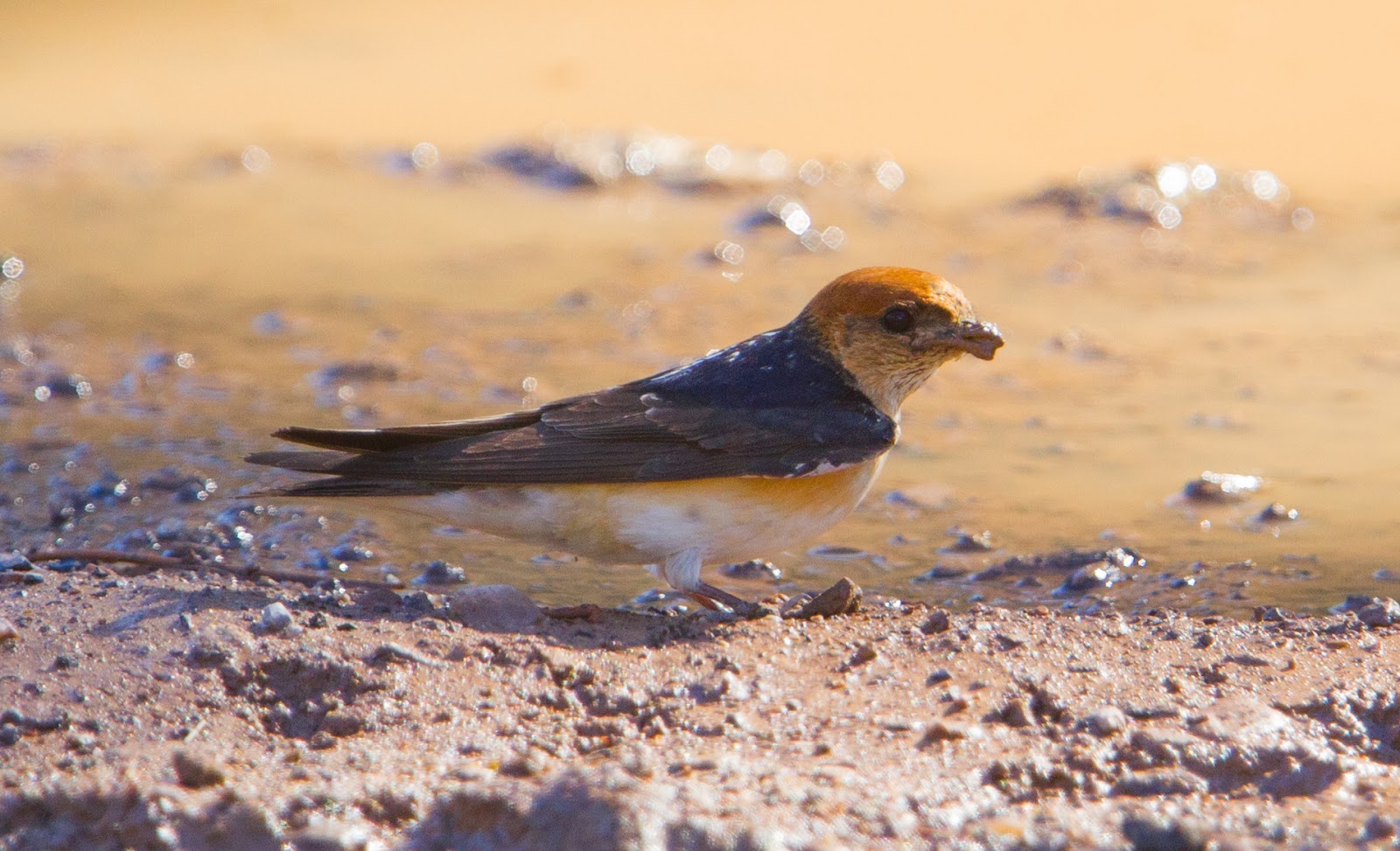
Fairy Martin collecting mud

Regent Honey-eater
By this time it was getting late so rather driving the 100 or so kilometres back to Katoomba we headed back to the campsite at Glen Davis for the night.
Next morning after breakfast with a group of White-winged Choughs around the van and noisy Little Lorikeets, Yellow-faced and White-plumed Honey-eaters feeding in the flowering trees overhead, we started a slow drive out of the valley. In one of the gardens were both Bar-breasted and Peaceful Doves together for a direct comparison, a group of Finches along the road contained Zebra and Red-browed Finches as well as some smart Chestnut-breasted Mannikin but Plum-headed Finch continued to elude us despite several stops at likely spots. Further stops along the road out of the valley to Capertee produced Red-rumped Parrots, Brown Falcon, Black-faced Cuckooshrike, Brown and White-throated Treecreepers and a selection of honey-eaters including Yellow-tufted, White-eared, White-naped,White-cheeked, Yellow-faced and White-plumed.
Wombat had been a much hoped for mammal and there were plenty of signs of recent activity but as before we were unable to find a live one although it was particularly distressing to find so many, some very recent, victims of roadkill. It is difficult to see how they can continue to survive given the amount of slaughter on some of the roads indeed that is also true of some of the Kangaroo species as well as in some areas dead animals litter the roads.
On a brighter note while we were in the valley a closer look at some of the kangaroos enabled to see that some were Common Walleroo something I had not realised until then as most sightings had been while driving along.
Leaving the valley heading back we decided to check out the Wolgan Valley which was interesting and scenic, a lunch stop by the river produced a few birds but nothing new. Another stop at Evans Lookout near Blackheath drew a blank while again we were looking for Rock Warbler and Pilotbird and a calling Channel-billed Cuckoo refused to come into view. We did however meet Carol Proberts here who was the guide I had hoped to use in the Blue Mountains who suggested some sites for us to check out adding that the Warblers were very often common in the car park where we were but as it was breeding time they were more likely down on the rock faces, we checked out a couple of suggested sites but they continued to elude us.
Friday was our last day in the Blue Mountains as we had to be in Sydney that evening, an early morning visit to the Three Sisters car park failed to produce anything new so we decided to head up to Jenolan Caves and after a very interesting drive down a long windy steep road arrived at the caves.
Walking down from the car park we encountered a Red-bellied Black Snake (  highly venomous !!)
not the first we had seen but the first we had come across while walking.

Three Sisters

Inside the caves at Jenolan

Red-bellied Black Snake

 While we were waiting for a tour of the cave we took a wander along the river where there were an amazing selection of Lizards most of which remain unidentified at present but there were a number of different species, mostly quite approachable, basking in the sun, the crystal clear pool also contained this splendid Platypus which gave a fantastic display.

Platypus

Water Dragon

Water Dragon
 After the tour of a very spectacular cave it was lunch time and time to move on as we still had a way to go. We had decided to take a different route down to Sydney travelling back to Lithgow and down the Bell's  Highway, at Lithgow we were stopped for a random breath test but were soon on our way, this route had been the most affected by the recent fires and we drove for many miles through blackened woodlands although to be fair it was apparent that only the scrubby undergrowth had been burnt and the larger trees were mainly untouched just scorched leaves even so there were a few properties that must have been very worried as the flames had appeared to come right up to the boundary but in most cases leaving them unscathed. It was with a lot of luck that I managed to find a turf farm in Windsor and there as hoped were 3 adult Banded Lapwings with 2 chicks in tow our 400th species and a most wanted one at that having missed them at Werribee despite much searching.
Our final night was spent at Lane Cove amid the usual selection of Parrots and Brush-Turkeys before visiting Sydney Bridge and the Opera House in the morning.
Finding our way across Sydney and returning the camper van proved to be a challenge in the late morning traffic but all went smoothly and we were at the airport in good time for the return journey home.